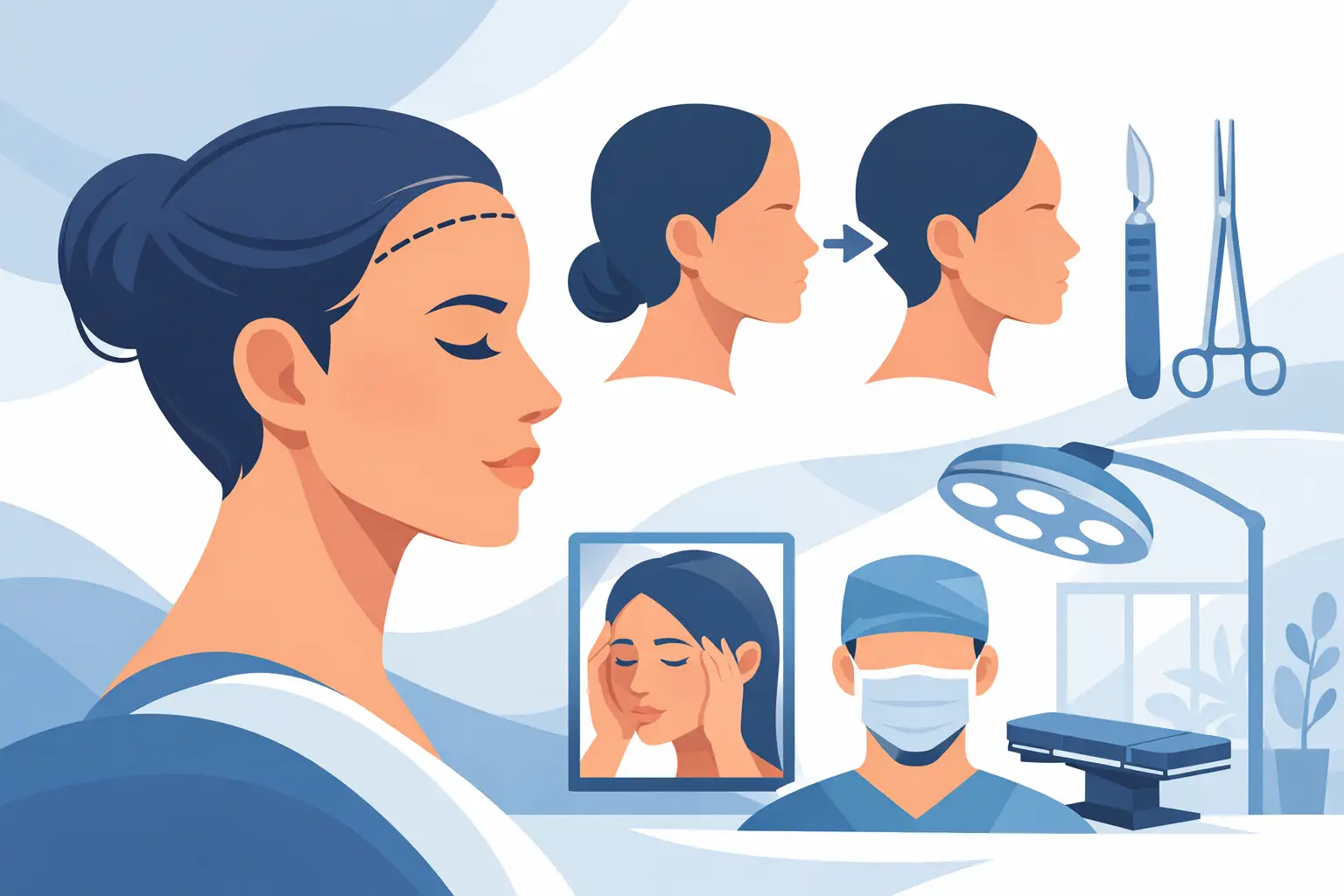
Is Forehead Bossing Reduction Surgery Right?
A prominent brow can affect the entire expression of the face. It may create a heavier appearance above the eyes, cast shadows across the upper face, or feel out of balance with otherwise refined facial features. Forehead bossing reduction surgery is designed to soften this projection by reshaping the frontal bone in a way that respects each patient’s anatomy, proportions, and aesthetic goals.
For many patients, the goal is not to create a completely flat forehead. A natural forehead has contour, structure, and variation. The objective is a smoother, more harmonious transition between the forehead, brow, and upper nose while preserving an appearance that still feels like your own.
What is forehead bossing?
Forehead bossing refers to a pronounced forward projection of the frontal bone, particularly in the area above the eyebrows. It can occur naturally as part of facial anatomy, be more noticeable in certain lighting, or become a specific source of concern when it creates a brow contour that feels overly strong or masculine.
The degree and location of prominence vary considerably. Some people have projection mainly at the center of the brow, while others have a broader, more prominent supraorbital rim extending toward the temples. This distinction matters because a safe surgical plan depends on the thickness and shape of the frontal bone, the position of the frontal sinus, and the relationship between the brow and the eyes.
Forehead contouring is often sought within facial feminization surgery, where reducing brow prominence can contribute to softer facial proportions. It can also be appropriate for patients of any gender who want to address a naturally prominent brow and achieve better facial balance. The indication is personal, not prescriptive.
How forehead bossing reduction surgery works
Forehead reduction is not a one-size-fits-all procedure. Before surgery, the surgeon evaluates the face as a whole, rather than treating the forehead as an isolated feature. Facial width, hairline position, brow shape, nasal bridge, cheekbone projection, and chin contour can all influence what will look balanced.
A detailed consultation generally includes a discussion of your concerns, medical history, previous facial surgery, and realistic goals. Imaging may be used to assess the underlying bone and the frontal sinus. This is particularly important because the sinus lies directly behind part of the brow area in many patients. Its size and position determine which technique can be performed safely.
Bone contouring or frontal sinus setback
When the bone in front of the sinus is sufficiently thick, the surgeon may be able to carefully contour and reduce the projection directly. This approach is often referred to as burring or bone shaving.
In patients with a more prominent frontal sinus or thinner bone over that area, simply shaving the surface may not provide enough reduction and could compromise safety. In these cases, a more advanced technique may involve temporarily removing the anterior wall of the frontal sinus, reshaping it, and setting it back into a more harmonious position. The reconstructed bone is secured to support stable healing.
The appropriate method depends entirely on anatomy. A surgeon who promises the same degree of flattening for every patient is not accounting for the limits that protect long-term function and appearance.
Incision placement and brow position
The incision is commonly placed within the hair-bearing scalp or along the hairline, depending on the treatment plan and whether hairline adjustment is also being considered. A scalp incision can conceal the scar effectively in many patients, while a hairline incision may be selected when advancing or refining the hairline is part of the desired result.
Forehead contouring may affect the soft tissues around the brow. In some cases, brow position is addressed during the procedure to maintain a rested, natural expression. This requires restraint. An overly elevated brow can look surprised, while insufficient attention to soft-tissue support may limit the aesthetic improvement achieved through bone contouring.
Who may be a candidate?
A suitable candidate is an adult in good general health who is bothered by a prominent brow contour and understands that the safest outcome is guided by their individual anatomy. Candidates should be nonsmokers or prepared to stop nicotine use before and after surgery, as nicotine can interfere with wound healing.
The consultation is also the right moment to discuss expectations openly. Surgery can substantially reduce projection and soften the upper face, but it cannot erase every natural contour. The forehead must remain structurally sound, and the final result should work with the rest of the face rather than appear artificially flat.
Patients with a history of sinus surgery, facial trauma, untreated medical conditions, or certain medications may need additional evaluation. Previous hair transplantation or concerns about hairline density should also be discussed, since these factors can influence incision planning.
Recovery after forehead contouring
Forehead bossing reduction surgery is typically performed under general anesthesia. Whether it is carried out in a private surgical setting or with hospital infrastructure depends on the extent of the procedure and the patient’s individual needs. For more extensive facial feminization surgery, the added resources of a hospital environment can offer appropriate reassurance and medical support.
Swelling and bruising around the forehead and eyes are expected during the early recovery period. The first week is usually the most visibly swollen, although the amount of swelling differs from person to person. A compression dressing may be used initially, and temporary numbness of the scalp or forehead can occur as tissues heal.
Most patients need time away from work and social commitments. Light activity can generally be resumed gradually, while strenuous exercise, contact sports, and activities that increase blood pressure should wait until the surgeon confirms that healing is progressing well. The forehead may look improved early on, but refinement continues as swelling resolves over several weeks and months.
Scar maturation also takes time. Incision care, sun protection, and follow-up appointments are part of achieving the best possible outcome. A careful recovery plan is not an afterthought. It is an essential part of surgical treatment.
Risks and safety considerations
As with any surgical procedure, forehead contouring involves risks. These can include bleeding, infection, delayed wound healing, unfavorable scarring, temporary or persistent changes in sensation, asymmetry, contour irregularities, and the possibility of revision surgery. When the frontal sinus is involved, specialized surgical planning is particularly important to minimize sinus-related complications.
Safety begins well before the operating room. It depends on accurate assessment, an experienced surgeon, a properly equipped surgical environment, and clear postoperative follow-up. Patients should feel comfortable asking which technique is recommended, why it suits their anatomy, where the procedure will be performed, and what recovery support is available.
At Singelberg Kliniek, facial procedures are approached with the same principle: a result should be aesthetically considered, medically responsible, and tailored to the individual rather than based on a standard template.
Considering forehead reduction as part of facial feminization surgery
For patients pursuing facial feminization, forehead contouring is often one of the most influential procedures because the brow area strongly affects how the face is read. Still, it does not need to be combined with every other facial procedure.
Some patients benefit from pairing forehead contouring with hairline work, rhinoplasty, or a brow lift because these structures are visually connected. Others prefer a staged approach, allowing healing and personal priorities to guide the next decision. Combining procedures can reduce the number of recovery periods, but it also creates a longer operation and may require more extensive recuperation. The right choice depends on health, goals, anatomy, and comfort with recovery.
A thoughtful surgical plan does not chase a generic ideal. It identifies the features that matter most to you and balances them with what can be achieved safely and naturally. When a prominent brow has long felt out of step with the rest of your face, a specialist consultation can provide the clarity needed to decide whether forehead contouring is the appropriate next step.