Is Liposuction for Abdomen and Flanks Right?
A body contour can remain resistant to healthy habits even when weight is stable. The lower abdomen may hold a small pocket of fat, while fullness at the waist can soften the transition from the torso to the hips. Liposuction for abdomen and flanks is designed to address these localized deposits and restore a more defined, balanced silhouette. It is not a shortcut for weight loss. It is a surgical contouring procedure for people whose concerns are specific, persistent, and appropriate for treatment.
The most refined outcomes do not come from removing the greatest possible amount of fat. They come from careful assessment, conservative technique, and an understanding of how the abdomen, waist, hips, skin quality, and overall proportions relate to one another.
What abdomen and flank liposuction can improve
The abdomen and flanks are often treated together because they form one visual unit. Treating only the front of the abdomen while leaving fullness at the sides can create an incomplete result. Conversely, selective treatment of the flanks can sharpen the waistline and improve the contour seen from the front, side, and back.
Depending on the individual anatomy, liposuction may improve a lower abdominal bulge, fullness above the hips, “love handles,” or uneven contour after weight changes. For some patients, it can make clothing fit more comfortably and create a smoother line through the waist. For others, the goal is subtle refinement rather than a dramatic change.
A natural result respects the patient’s existing shape. The intention is not to create an identical contour for every body, but to remove localized fat strategically while preserving proportion and softness where appropriate.
Who is a good candidate for liposuction for abdomen and flanks?
A suitable candidate is generally close to a stable, healthy weight and has realistic expectations about what surgery can achieve. The concern should be a localized area of fat that does not respond as desired to nutrition and exercise. Good skin elasticity is also valuable, because the skin must adapt to the reduced volume beneath it.
Age alone does not determine candidacy. Skin quality, connective tissue, prior pregnancies, weight fluctuations, medical history, and the amount and location of fat all matter. Men and women may have different contour patterns: men may seek a cleaner transition across the abdomen and waist, while women may be concerned with the waistline and the fullness over the hips. Each treatment plan should be based on the person in front of the surgeon, not on a standard template.
Liposuction may be less suitable when there is significant loose abdominal skin, marked muscle separation, or a pronounced skin overhang. In these situations, removing fat alone may not address the underlying concern and can sometimes make skin laxity more noticeable. A tummy tuck, with or without liposuction, may offer a more appropriate solution. During a consultation, this distinction should be discussed clearly before any decision is made.
The consultation: planning beyond the treatment area
A thoughtful consultation begins with what the patient sees and feels, but it should go further. The surgeon evaluates the quality and thickness of the skin, the distribution of fat, abdominal wall tone, scars from previous procedures, and body symmetry. Photographs and clinical examination help determine whether the concern is primarily subcutaneous fat, skin laxity, muscle separation, or a combination of factors.
Medical safety is equally central. A complete medical history, current medications, smoking or nicotine use, previous surgery, and any conditions that may affect anesthesia or healing must be reviewed. Patients should also be open about weight changes and their desired outcome. The clearest plans are built when expectations are specific but realistic.
This is also the moment to discuss the extent of treatment. Some patients benefit from contouring the abdomen and flanks alone. Others may consider adjacent areas to maintain a smooth transition. More treatment is not automatically better. The safest and most aesthetic approach depends on the amount of fat to be removed, the patient’s tissue quality, and the surgical setting.
How abdominal and flank liposuction is performed
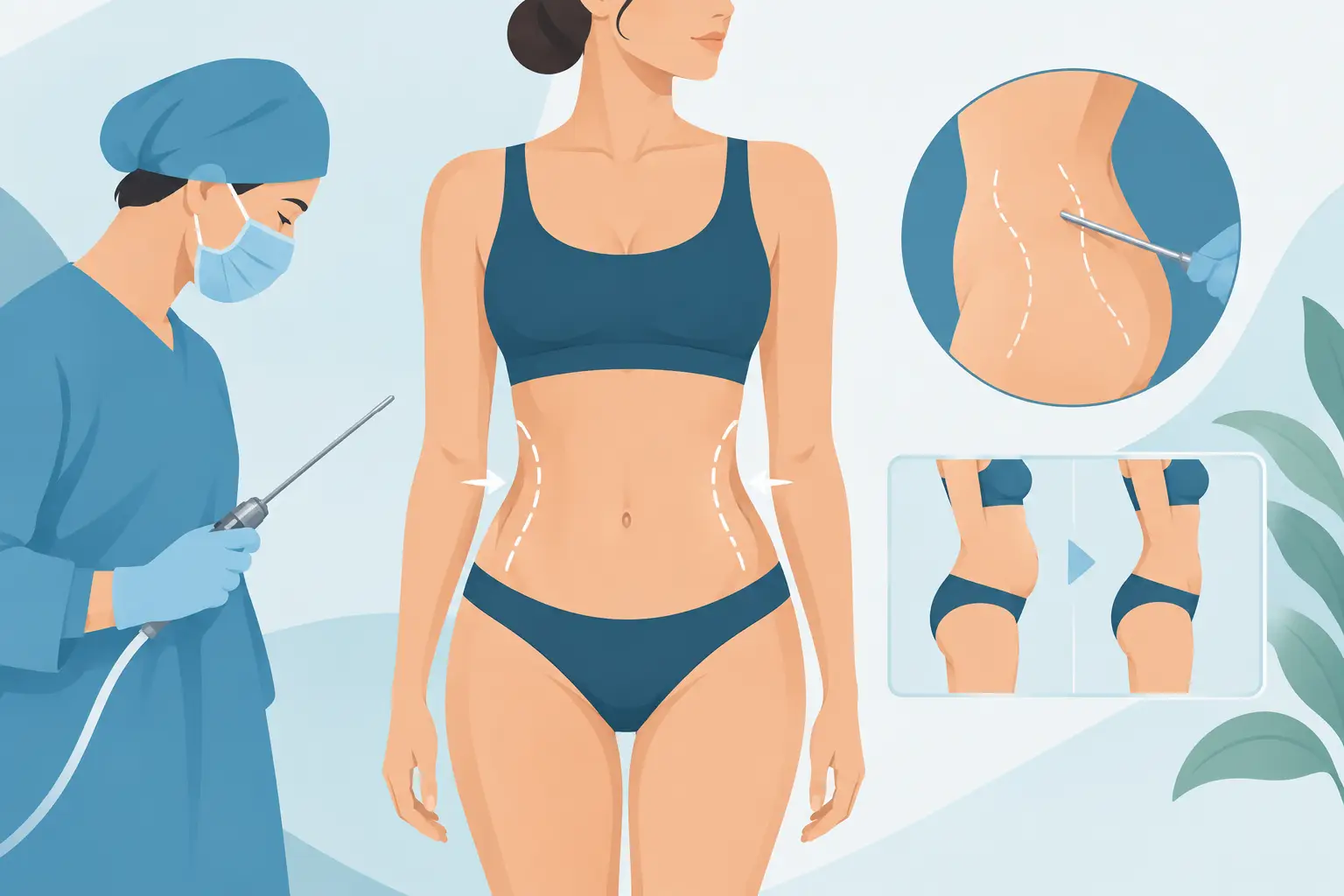
Liposuction is performed through very small incisions, placed as discreetly as possible. After the treatment area is marked, a solution is introduced into the fatty tissue to help reduce bleeding and facilitate fat removal. A slim cannula is then used to remove fat in controlled layers.
The technique requires precision. Removing too much fat close to the skin can increase the risk of contour irregularities, while removing too little may leave the original concern largely unchanged. The surgeon continuously considers the depth of treatment and the transition between treated and untreated areas. This is particularly relevant around the waist, where subtle asymmetry can be visible.
The choice of anesthesia and facility depends on the scope of the procedure and the individual medical assessment. Smaller procedures may be appropriate in a fully equipped private clinical setting, while more extensive surgery may benefit from hospital infrastructure. Safety, monitoring, and appropriate aftercare should guide that decision.
Recovery: what to expect after surgery
Most patients experience swelling, bruising, tenderness, and a feeling of firmness in the treated areas during the first phase of recovery. These effects are expected and gradually improve. A compression garment is commonly worn to support the tissues and help control swelling while the body heals.
Light walking is encouraged early, both for comfort and circulation, but strenuous activity, heavy lifting, and intensive exercise should wait until the surgeon confirms that it is safe. The exact timing varies with the extent of treatment and the patient’s recovery. Many people return to desk-based work within several days to two weeks, although residual swelling can remain visible for longer.
The first result may be apparent once early swelling starts to settle, but the contour continues to evolve over several months. This requires patience. The body needs time for fluid shifts to resolve, skin to contract as much as it can, and the tissues to soften.
Following postoperative instructions is part of protecting the result. Patients should attend scheduled follow-up appointments, wear compression as advised, avoid nicotine, maintain stable weight, and contact the clinic promptly if they have concerns about increasing pain, fever, unusual swelling, or wound changes.
Results and the role of skin quality
Fat cells removed by liposuction do not return in the same location. However, the remaining fat cells can enlarge with substantial weight gain. Long-term contour maintenance therefore depends on stable lifestyle habits and realistic weight management.
Skin behavior is one of the greatest variables. Younger or more elastic skin may retract smoothly after fat removal, while skin affected by pregnancy, significant weight loss, aging, or sun damage may not tighten to the same degree. No responsible surgeon can promise a perfectly flat abdomen or guarantee identical skin contraction in every patient.
Small contour irregularities, temporary numbness, prolonged swelling, asymmetry, and the need for revision are potential considerations with any liposuction procedure. A qualified plastic surgeon will explain these risks in relation to your specific anatomy and help you weigh them against the likely benefit. An honest discussion before surgery is a sign of careful care, not a reason for alarm.
Choosing a measured approach
The abdomen is often treated as a simple problem area, but it is one of the most individual parts of body contouring. A refined waistline can depend as much on flank treatment, skin quality, and abdominal wall assessment as on fat removal itself. For this reason, a personal consultation should focus not only on whether liposuction is possible, but on whether it is the right procedure for your goals and anatomy.
The best next step is to bring clear questions to a consultation and choose a surgical team that values safety, discretion, and a result that still looks like you – simply more in balance.