Facelift Versus Fat Transfer: Which Fits You?
A face can look tired for two very different reasons: the tissues may have descended, or the face may have lost the soft volume that once supported its contours. That distinction is at the center of facelift versus fat transfer. Although these treatments are often presented as alternatives, they solve different anatomical concerns and are frequently most effective when thoughtfully combined.
The right choice is not determined by age alone or by a single photograph. It depends on skin quality, facial structure, the position of the deeper tissues, the degree of volume loss, and the result you want to preserve over time. A careful facial analysis helps separate what can be improved with restored volume from what requires repositioning of the facial tissues.
Facelift versus fat transfer: the essential difference
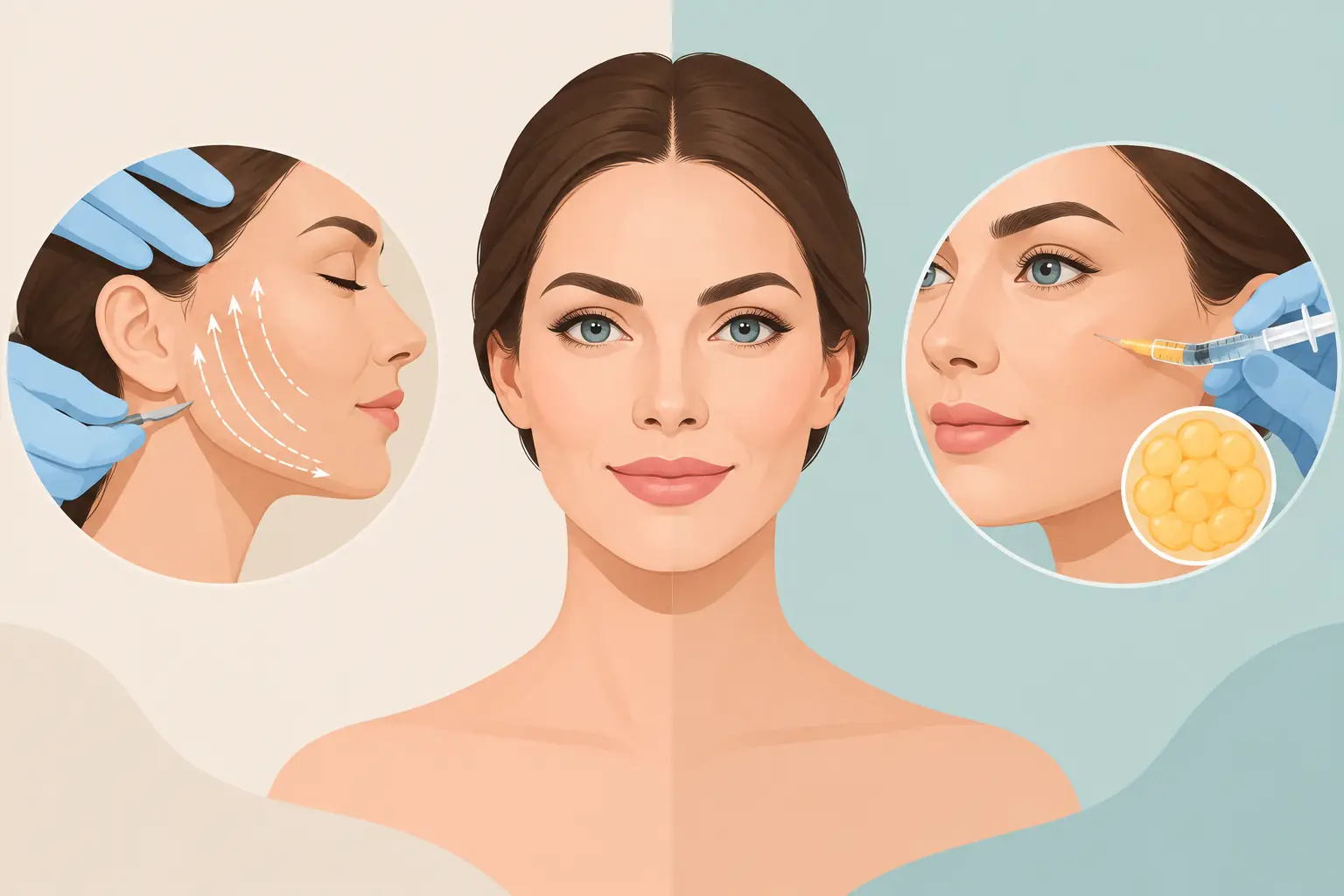
A facelift is a surgical procedure designed to reposition descended facial tissues and refine the jawline, cheeks, and neck. Modern techniques focus on restoring the underlying support of the face rather than simply tightening the skin. This is especially relevant for patients with jowls, a softened jawline, loose neck skin, deep folds around the mouth, or cheeks that have shifted downward.
Fat transfer, also called autologous fat grafting, uses a patient’s own fat to restore volume. Fat is carefully harvested from an area such as the abdomen, flanks, or thighs, purified, and placed in small amounts in selected facial areas. It can soften hollow temples, replenish the cheeks, improve under-eye hollows in appropriate candidates, and support the contours around the mouth and chin.
In simple terms, a facelift lifts and repositions. Fat transfer fills and supports. A facelift cannot fully replace lost volume, while fat transfer cannot reliably correct significant tissue descent or remove loose neck skin.
When a facelift is the more appropriate choice
A facelift is generally considered when the primary concern is laxity. Patients may notice that their face looks heavier in the lower third, that the jawline is no longer defined, or that the neck appears less firm despite a stable body weight and good skincare habits. In these situations, adding volume alone may make the face appear fuller without addressing the cause of the sagging.
For suitable candidates, a deep plane facelift can provide a refined approach to midface descent, jowls, and the neck and jawline. Rather than relying on skin tension, the technique releases and repositions deeper facial layers. The goal is not to create an altered or overly pulled appearance. It is to restore more natural facial proportions and definition while respecting each person’s unique anatomy.
A facelift is a surgical treatment and requires realistic planning for recovery. Bruising, swelling, and temporary changes in sensation are expected parts of healing. Most patients need a period away from social and professional commitments, although the visible recovery timeline varies. Final refinement develops gradually as swelling settles and the tissues adapt to their new position.
The longevity of a facelift is one of its advantages. It does not stop the aging process, but it can set back the visible effects of tissue descent for many years. Skin quality, genetics, sun exposure, smoking, weight fluctuations, and skincare all influence how the result ages.
When fat transfer may be the better fit
Fat transfer is often best suited to a face that has become hollow rather than markedly loose. Volume loss can make the temples look recessed, the cheeks appear flatter, and the area beneath the eyes look more shadowed. These changes may occur with natural aging, weight loss, genetics, or previous overcorrection with other treatments.
Because transferred fat is living tissue, it can create a soft and natural-feeling result. It may also be an appealing option for patients who prefer to avoid synthetic fillers or who need volume restoration across several areas of the face. Once the transferred fat has established a blood supply, the surviving cells can remain long term.
However, not all transferred fat survives. Some resorption is normal and cannot be predicted with complete precision, which is why surgeons may slightly account for this during planning. In certain cases, a second session may be considered to refine volume after healing. Fat transfer is also technique-sensitive: careful placement in small, controlled amounts is essential to prevent irregularities and achieve a balanced result.
Fat transfer involves both a donor area and the face. The recovery is therefore different from injectable filler treatment. Swelling and bruising can occur in the treated facial areas, while tenderness and bruising may also be present where the fat was harvested. It is less invasive than a facelift, but it is still a surgical procedure that deserves the same careful medical assessment and aftercare.
Why combining a facelift and fat transfer can look more natural
A youthful face is not defined by tight skin alone. It has a balanced relationship between contour, volume, and tissue position. For many patients with both sagging and hollowing, a facelift with targeted fat transfer creates a more complete correction than either procedure alone.
For example, lifting the cheeks and lower face can improve the jawline and soften folds, while a modest amount of fat transfer can restore support in the temples or upper cheeks. The result should not be a dramatically different face. It should look rested, proportionate, and consistent with the patient rather than a trend.
Combination treatment is not automatically better. A face with adequate volume may not benefit from added fat, and excessive filling can obscure definition. Conversely, a patient with minimal laxity may achieve a meaningful improvement with fat transfer alone, possibly combined with non-surgical skin treatments that address texture and quality. The treatment plan should be based on what the face needs, not on a fixed package of procedures.
What about fillers and skin treatments?
Hyaluronic acid fillers can be useful for subtle, temporary volume correction and may suit patients who are not ready for surgery. They can also help clarify whether restoring volume improves a specific concern. Yet fillers have limits. Repeated use to compensate for substantial sagging can lead to an increasingly heavy or overfilled appearance rather than a refreshed one.
Skin quality also matters. A facelift improves the position of facial tissues, but it does not erase sun damage, enlarged pores, pigment changes, or fine surface lines. Depending on the skin assessment, treatments such as medical peels, microneedling, PRP, or energy-based treatments may complement surgical planning. These options are selected for skin condition, not used as a substitute for surgery when deeper structural correction is needed.
Safety and candidacy deserve more attention than trends
Whether considering a facelift, fat transfer, or both, safety begins with an in-person consultation. Your medical history, medications, smoking or nicotine use, previous facial procedures, weight stability, and healing capacity all matter. Good candidates are generally in good overall health, have realistic expectations, and can follow recovery instructions closely.
A qualified surgeon should assess the face in motion as well as at rest, examine skin thickness and elasticity, and discuss where scars would be placed if surgery is recommended. For a facelift, the quality of the neck, jawline, and midface must be evaluated together. For fat transfer, the available donor fat, the quality of the recipient tissues, and the amount of correction needed should be considered.
It is also appropriate to ask direct questions: Which concern will this procedure improve most? What will it not change? How long is the expected recovery? Where will surgery take place, and what level of medical support is available? A premium aesthetic result depends on surgical judgment, meticulous technique, and a setting designed for patient safety and discreet follow-up.
Choosing the treatment that respects your features
The most convincing facial rejuvenation rarely announces itself. Friends may notice that you look rested, healthier, or more like yourself, without identifying why. That outcome comes from avoiding a one-size-fits-all decision between lifting and filling.
At Singelberg Kliniek, facial rejuvenation planning begins with a personal assessment of the structures that have changed and the result you hope to achieve. If the concern is descent, a facelift may offer the strongest correction. If it is hollowing, fat transfer may be the more elegant solution. And when both are present, a measured combination can restore balance without sacrificing natural expression. The best next step is a consultation focused not on choosing a trend, but on understanding your face.